






ICD-10 Code for Transaminitis Brief Clinical & Billing Overview

Transaminitis refers to elevated liver transaminases—alanine aminotransferase (ALT) and/or aspartate aminotransferase (AST) identified on laboratory testing. Clinically, it is a finding, not a definitive diagnosis, and often prompts further evaluation for hepatic, metabolic, infectious, or medication-related causes.
From a billing and coding standpoint, correct ICD-10-CM selection depends on what is documented: an abnormal lab result versus a confirmed underlying condition.
Primary ICD-10-CM Code for Transaminitis
R74.01 – Elevated alanine aminotransferase [ALT] level
When to use:
- Provider documents transaminitis or elevated liver enzymes without identifying a definitive cause.
- ALT elevation is specified or implied.
- Used as a sign/symptom code when no confirmed hepatic diagnosis is established.
Coding notes:
- Appropriate for outpatient and professional claims.
- Acceptable as a primary diagnosis when the visit is focused on evaluating abnormal liver enzymes.
Related: ICD-10 Code for Diarrhea: R19.7
Related & Alternative ICD-10 Codes
Use a more specific code when documentation supports it:
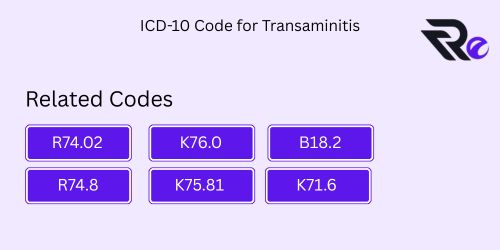
- R74.02 – Elevated aspartate aminotransferase [AST] level
- R74.8 – Abnormal levels of other serum enzymes
- K76.0 – Fatty (change of) liver, not elsewhere classified
- K75.81 – Nonalcoholic steatohepatitis (NASH)
- B18.2 – Chronic viral hepatitis C
- K71.6 – Toxic liver disease with hepatitis
Documentation Rules
- Do not code transaminitis if the provider confirms an underlying diagnosis (e.g., hepatitis, cirrhosis).
- Link abnormal labs to the condition when clinically established.
- Use lab findings alone only when no definitive diagnosis is made.
Services Commonly Supported by Transaminitis Coding
Transaminitis codes may support medical necessity for:
Diagnostic Testing
- Hepatic function panel
- Viral hepatitis serologies
- Autoimmune markers
- Imaging (ultrasound, CT, MRI if documented)
Procedures & Follow-Ups
- Liver biopsy (when medically justified)
- Specialist referrals (gastroenterology/hepatology)
- Repeat lab monitoring
DME & Ancillary
- Typically not covered solely for transaminitis unless tied to a chronic liver condition.
Includes vs. Excludes
Includes
- Isolated elevation of ALT/AST
- Asymptomatic abnormal liver enzymes
- Transaminitis noted as a clinical finding
Excludes
- Confirmed liver disease with established diagnosis
- Alcoholic liver disease (code to K70.-)
- Acute or chronic viral hepatitis (code to B15–B19)
Common CPT® / HCPCS Pairings
Frequently paired services include:
- 84460 – Alanine aminotransferase (ALT)
- 84450 – Aspartate aminotransferase (AST)
- 80053 – Comprehensive metabolic panel (CMP)
- 80076 – Hepatic function panel
- 76705 – Limited abdominal ultrasound (when documented)
Ensure diagnosis-pointer alignment on claims to avoid medical necessity denials.
Denial & Audit Risk Tips
- Avoid using R74.01 when a definitive hepatic diagnosis is documented in the same encounter.
- Ensure provider notes clearly state clinical assessment, not just lab values.
- Watch payer edits that flag transaminitis as incidental if labs are part of routine screening.
- For audits, confirm that abnormal results were evaluated, monitored, or acted upon.
Frequently Asked Questions
What is the ICD-10 code for transaminitis?
R74.01 is the most commonly used ICD-10-CM code when transaminitis or elevated ALT is documented without a confirmed diagnosis.
Can transaminitis be billed as a primary diagnosis?
Yes, when the encounter is focused on evaluating elevated liver enzymes and no underlying condition is confirmed.
Should I code transaminitis with fatty liver disease?
No. If fatty liver or another hepatic condition is diagnosed, code the definitive condition instead.
Is transaminitis considered a diagnosis or a symptom?
It is a laboratory finding/symptom, not a standalone disease.
Which labs support medical necessity for R74.01?
ALT, AST, hepatic panels, and follow-up testing are commonly supported when clinically documented.
Summary
Transaminitis is best coded using R74.01 when elevated liver enzymes are documented without a confirmed cause. Accurate documentation, correct code selection, and appropriate CPT pairing are essential to reduce denials and audit risk. Always code to the highest level of specificity supported by the provider record.