






Space Force Orbital Warship Carrier: What It Is, How It Works, and Why It Matters
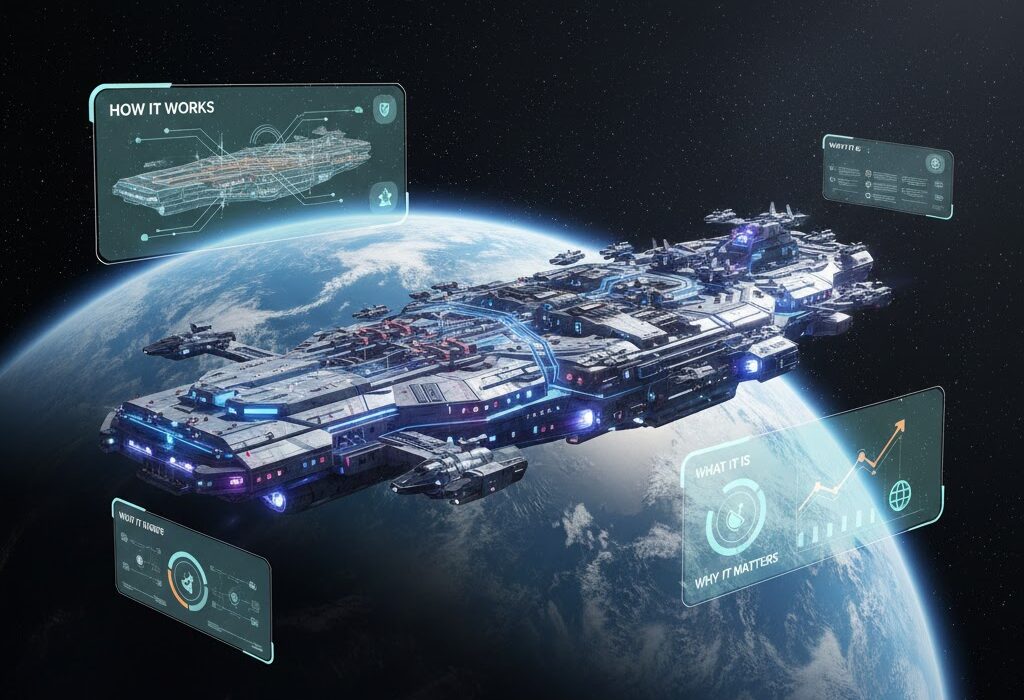
The idea of a Space Force orbital warship carrier may sound like science fiction—but it’s rapidly moving into the realm of real-world defense strategy. Backed by the U.S. Space Force and developed in partnership with aerospace company Gravitics, this concept represents a major shift in how satellites could be deployed, protected, and maneuvered in orbit.
Table of Contents
ToggleRather than launching satellites one at a time from Earth, the orbital carrier envisions a pre-positioned platform in space capable of rapidly deploying payloads when and where they’re needed. This article explains what the orbital carrier is, why it matters, and how it could reshape space warfare, national security, and even civilian life.
What Is the Space Force Orbital Warship Carrier?
At its core, the orbital warship carrier is a large, unpressurized spacecraft designed to operate as a space-based launch and deployment platform.
Instead of relying solely on ground-based rockets, the carrier would:
- Store multiple satellites or space vehicles in orbit
- Deploy them on demand during crises
- Protect sensitive payloads from environmental and hostile threats
The project is supported by a $60 million U.S. Space Force contract, signaling serious institutional interest rather than speculative experimentation.
How the Orbital Carrier Works
A New Model for Satellite Deployment
Traditional satellite launches face several limitations: long preparation timelines, fixed launch windows, and vulnerability during ascent. The orbital carrier model changes this entirely.
Key operational features include:
- On-orbit storage: Satellites are housed securely until needed
- Rapid deployment: Assets can be released within hours or days, not months
- Flexible positioning: Payloads can be deployed into multiple orbits
This agility provides a significant strategic advantage in contested or unpredictable environments.
Why the Space Force Is Investing in Orbital Carriers
1. Faster Response in Space Conflicts
In modern warfare, space assets are critical for:
- Communications
- Navigation (GPS)
- Missile warning systems
- Intelligence and surveillance
An orbital carrier allows the Space Force to replace or reinforce satellites quickly if existing systems are damaged or disabled.
2. Protection Against Space Threats
Orbital carriers are designed to shield payloads from:
- Radiation and solar storms
- Micrometeoroids and debris
- Potential anti-satellite (ASAT) attacks
This defensive role is just as important as deployment capability.
3. Reduced Dependence on Ground Launches
By minimizing reliance on Earth-based launches, the U.S. gains:
- Fewer logistical bottlenecks
- Lower exposure to launch-site vulnerabilities
- Greater operational secrecy
The Role of Gravitics and Private-Sector Innovation
The Gravitics–Space Force partnership reflects a broader trend in defense and aerospace: public–private collaboration.
Gravitics brings:
- Expertise in large-space-structure design
- Commercial innovation speed
- Modular spacecraft concepts
This mirrors similar partnerships seen with companies like SpaceX and Axiom Space, where private-sector agility complements government oversight and funding.
Why This Matters Beyond the Military
Civilian Technology Depends on Space
Everyday systems rely on satellites, including:
- GPS navigation
- Weather forecasting
- Internet and mobile communications
- Financial transaction timing
Protecting and rapidly restoring these assets is not just a military concern—it’s an economic and societal one.
Global Implications and Space Competition
Other nations are also advancing space capabilities. With China and others investing heavily in orbital infrastructure, the emergence of orbital carriers raises critical questions:
- Will space remain a shared domain or become militarized?
- Can competition coexist with international cooperation?
- How will space law evolve to address on-orbit deployment platforms?
These questions will shape the next several decades of space policy.
Ethical and Strategic Considerations
While the technology is impressive, it also introduces challenges:
- Risk of escalating space-based arms competition
- Ambiguity between defensive and offensive capabilities
- Need for updated international norms and treaties
The orbital carrier is not just a technical leap—it’s a strategic and ethical inflection point.
Summary:
The Space Force orbital warship carrier represents a transformative shift in space operations. By enabling rapid satellite deployment, enhancing asset protection, and reducing dependence on ground launches, it offers a powerful new tool for national security.
At the same time, it underscores a broader reality: space is no longer just a frontier of exploration—it’s a critical domain of infrastructure, competition, and responsibility.
As this technology develops, its impact will extend far beyond defense circles, shaping how humanity operates—and cooperates—beyond Earth.